
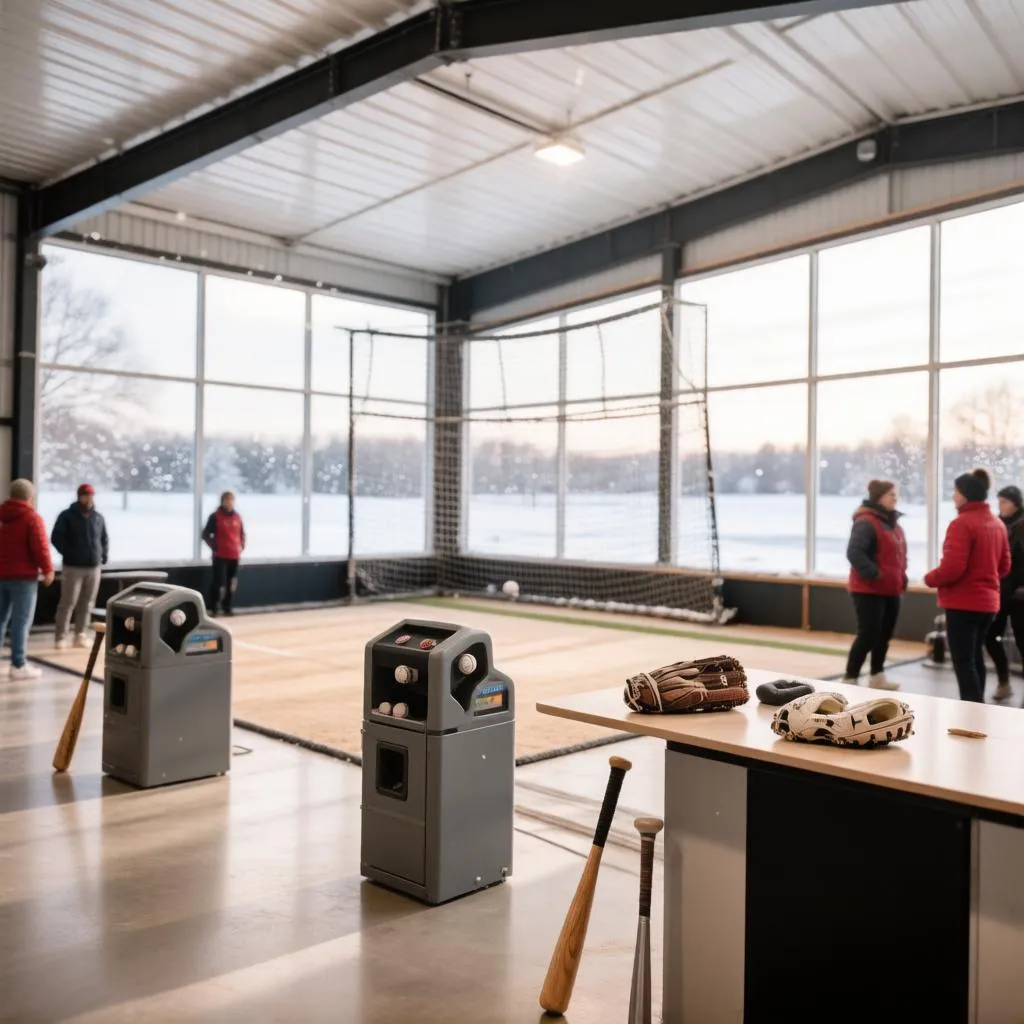
Every Gahanna baseball and softball parent knows the moment. It is late October, the fall season has wrapped, the gloves go into the garage — and by January, the swing that took all spring to build is a distant memory. Ohio’s offseason runs from November through March, and for young players the difference between showing up rusty in April and showing up ready often comes down to what happened indoors over those winter months.
The good news for families around Gahanna is that the northeast Columbus corridor is unusually rich in training options. Some sit literally inside the city limits, others are a fifteen- or twenty-minute drive away, and the range runs from coin-operated machine cages to data-driven HitTrax simulators and full indoor turf fields. The challenge is not finding a place to swing a bat in February — it is matching the right facility to your player’s age, goals and budget. Here is a practical map of what exists, what it costs and how to use a winter well.
Why indoor work actually matters
Before comparing venues, it is worth being clear about what winter training is for. Baseball and softball are timing sports, and timing decays: a hitter who takes no swings between October and April is effectively restarting the season from zero, which is why so many players look lost for the first month back outdoors. Pitchers face the same problem in reverse — building arm strength safely takes weeks of gradual throwing, and cramming that into April is how early-season injuries happen.
Winter facilities solve the weather problem, but the best ones solve more. Machine cages let a hitter face hundreds of consistent pitches in the time a live practice might deliver twenty. Tunnels allow pitching work at full effort regardless of snow outside. Simulators like HitTrax measure exit velocity, launch angle and distance, turning a guessing game into feedback. And for players between leagues, the winter months are the one stretch of the year where skill-building is possible without a game schedule competing for attention.
Three options inside Gahanna itself
Families who want to stay within Gahanna’s borders have a genuine choice, which is rarer than most people assume. Each of the three local venues does a different job, and they complement rather than replace each other.
D-BAT Columbus East is the closest thing Gahanna has to a dedicated baseball headquarters. Located on Taylor Station Road, the facility features ten batting cages that throw real baseballs and softballs — a meaningful distinction from the foam-ball machines at entertainment centers, because hitting a real baseball with real feedback is what builds timing. The D-BAT network pairs its cages with professional instruction, camps and clinics, and its machine cages run on a first-come, first-served basis, open long hours on weekdays and weekends alike. For a GJLS-age player who simply needs regular swings between seasons, it is the most convenient option in town.
REP Fieldhouse, on North Hamilton Road just over the border in northeast Columbus, takes a different approach. Its 23,000 square feet hold two hardwood basketball courts, a turf field, a HitTrax simulator and a training staff covering baseball and softball alongside other sports. This is the venue for players who want measured feedback rather than blind repetition — the HitTrax system shows exactly what each swing produces — and for athletes training multiple sports under one roof.
Gahanna Sports Factory on Morrison Road rounds out the local picture as a multi-use indoor space built for practices, instruction and training across sports, with baseball and softball work among its offerings. It is the kind of facility teams and small groups gravitate to for turf time and drills, and a sensible answer for players who need fielding and throwing reps as much as hitting.
The three venues side by side show how differently “indoor training” can look:
| Facility | Location | What’s inside | Best suited to |
|---|---|---|---|
| D-BAT Columbus East | 650 Taylor Station Rd, Gahanna | 10 cages with real baseballs and softballs, lessons, camps | Regular solo hitting reps and instruction |
| REP Fieldhouse | 5524 N Hamilton Rd, Columbus | HitTrax simulator, turf field, multi-sport training staff | Data-driven hitters and multi-sport athletes |
| Gahanna Sports Factory | 776 Morrison Rd, Gahanna | Multi-use indoor space for practices and instruction | Team drills, small groups, general turf time |
| Strike Zone | 6796 Thrush Dr, Canal Winchester | 6 indoor cages, lessons, pro shop, camps and leagues | Structured instruction and winter leagues |
| Mannino’s Grand Slam USA | 6635 Dublin Center Dr, Dublin | A dozen cages and tunnels, 40–85 mph machines, hitting leagues | Older players wanting game-speed pitching |
| Bat Flip Baseball | Hilliard | 4 HitTrax cages, 3 training tunnels, small-group classes | Modern, metrics-focused development |
| RSC Athletics | 13260 National Rd SW, Etna | 17,000 sq ft indoor dome with cage time and lessons | East-side families wanting full training under one roof |
Read across the rows and the pattern is clear: Gahanna’s own facilities cover convenience and general training, while the wider corridor supplies the specialists. A family that uses D-BAT for weekly swings and books occasional HitTrax sessions at REP Fieldhouse has effectively built a complete winter program without a single drive longer than fifteen minutes.
A short drive opens more doors
Beyond the city limits, central Ohio’s training scene rewards a little windshield time. Mannino’s Grand Slam USA in Dublin is the granddaddy of the region — operating since the late 1980s, with roughly a dozen cages and tunnels, pitching speeds ranging from 40 to 85 mph, and winter hitting leagues that turn practice into competition. It is the destination for travel-ball-age players who need to face faster pitching than a local facility typically offers.
The Strike Zone in Canal Winchester serves the southeast side with six indoor cages, private instruction across hitting, pitching and fielding, a pro shop and winter hitting leagues — its evening hours on weekdays fit neatly around school schedules. Hoagy’s All Americans on Columbus’s north side is a dedicated indoor baseball and softball facility with a long local reputation, while Bat Flip Baseball in Hilliard represents the modern end of the market: HitTrax cages, data-driven instruction and small-group classes built around measurable progress. And RSC Athletics in Etna, minutes east off I-70, has expanded into a 17,000-square-foot indoor dome offering cage time alongside baseball, softball and basketball training — with a free first visit that lowers the risk of trying something new.
Distance is the real currency here. A facility twenty minutes away that your player visits twice a week beats a world-class one forty minutes away visited twice a winter. Commitment, not square footage, is what turns a winter into progress.
Choosing between a cage and a classroom
Facilities differ most in what they are built to produce, and the honest way to choose is to define what your player actually needs this winter. The questions below sort most families into the right category quickly:
- Does your player need volume or instruction? Machine cages build reps cheaply; lessons build technique. Most young players need both, in that order.
- Is this maintenance or a development push? A rec-league player keeping sharp needs far less than a travel player chasing a roster spot.
- Does your player respond to data? Some hitters thrive on exit velocity charts; others drown in them. HitTrax is a tool, not a religion.
- Is the goal solo work or team chemistry? Winter is also when travel teams book shared tunnels — group sessions have their own value.
- How far will you actually drive in January? An honest answer prevents expensive memberships that die by February.
The answers usually point to a simple division: casual and rec-league players do best with pay-as-you-go cage time close to home, while committed travel players justify memberships, lessons and the longer drives to specialised facilities. Neither profile is better — they are just different winters.
Spending the winter well
Cage time without a plan evaporates into repetition without progress, and the winter is long enough to build real skills if the sessions have structure. The sequence that works for most players looks like this:
- Book an assessment or a single lesson in November to identify the two or three things worth working on before spring.
- Commit to a fixed weekly slot — same day, same hour — because scheduled repetition survives Ohio winters better than good intentions.
- Split cage time between hitting and defensive work; winter is the best window for throwing programs and pitching mechanics, not just swings.
- Add one measurable element, whether HitTrax sessions, velocity tracking or simple video, so progress is visible in February rather than assumed.
- Ramp throwing and hitting volume gradually through January and February, arriving at tryouts with the arm and swing already warm rather than starting from scratch.
The fifth step is where winters are won or lost. Players who ramp too late arrive at spring evaluations sore and behind; players who ramp too early peak in February and flatten by April. A steady climb, laid out in the cold months, is the whole trick.
What the winter actually costs
Pricing across the corridor follows a familiar structure, and knowing the bands helps families budget honestly. Machine cage time at D-BAT-style facilities typically runs from the high teens for a half hour to around fifty dollars for a full hour at non-member rates, with memberships in the forty-to-sixty-dollar monthly range unlocking discounts on rentals, lessons and pro shop gear — and D-BAT memberships carry across all their locations. Token-based machines at entertainment venues cost a few dollars for a bucket, which makes them a fine supplement but a poor core of a training plan. Private lessons generally run from thirty to eighty dollars depending on the instructor and the technology involved, and team or tunnel rentals are usually priced by the hour for groups.
Two booking realities deserve respect. First, prime time is scarce: from January onward, the after-school and evening slots at every good facility fill with travel programs, so families who wait until February often find the convenient hours gone. Second, facilities publish their own schedules and holiday closures — the Strike Zone, for instance, runs reduced winter hours and shuts down for Thanksgiving week — so a quick call or website check before a drive saves a wasted trip.
Making winter count
The Columbus area gives Gahanna families something many youth baseball markets cannot: a genuine ladder of indoor options, from coin machines to data-driven academies, all within reach of Taylor Station Road. The winning formula is unglamorous — one convenient home base for weekly reps, one specialised destination for instruction or measurement, and a plan that treats November through March as a season of its own rather than a gap between seasons.
Spring arrives at the same date every year, but players do not arrive at spring in the same condition. The ones who spent the winter taking real swings, facing real baseballs and building arm strength on a schedule will step onto the first dry field in April already in mid-season form — and everyone else will spend the first month catching up to them.