
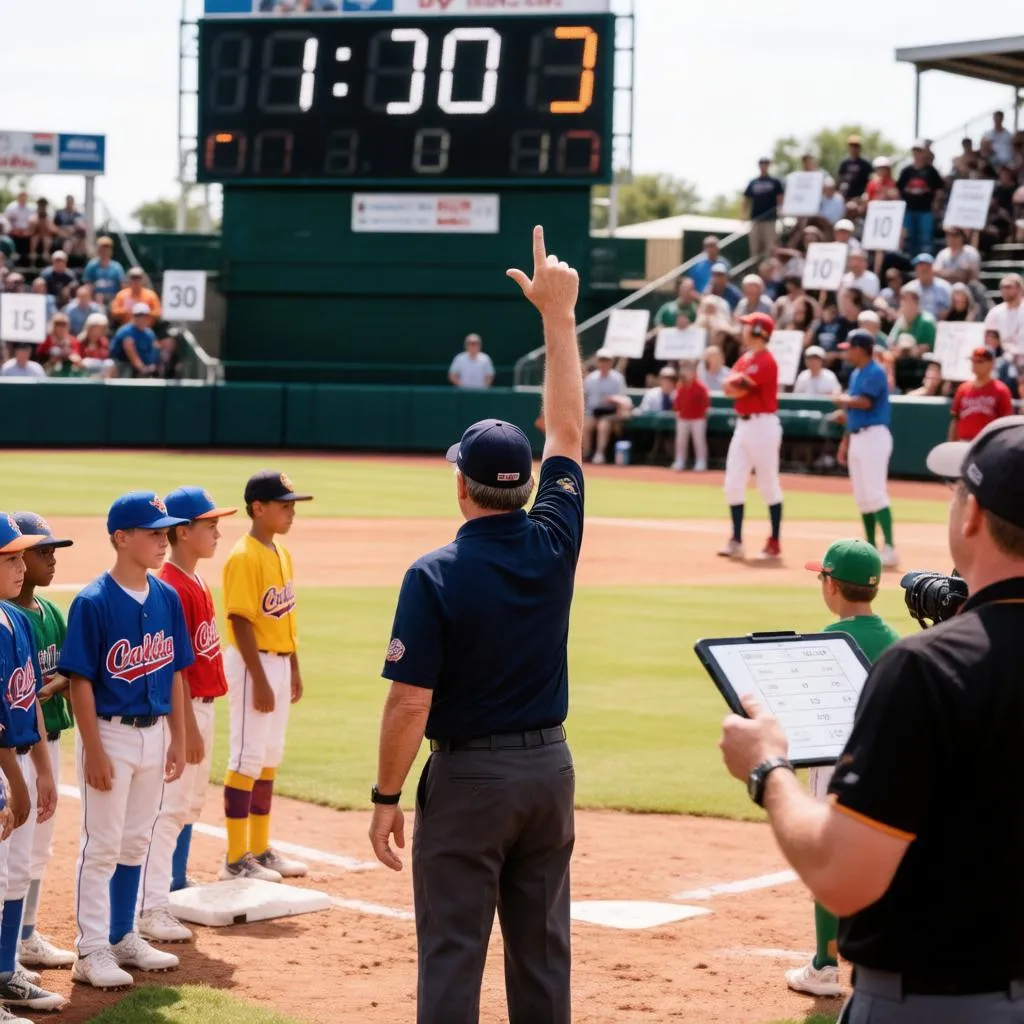
Tournament baseball runs on a clock in a way that regular season games never do. Fields are booked back to back, umpires move between diamonds, and organizers have to guarantee that every team finishes its games before dark. That pressure produces a set of rules — time limits, mercy rules, and tie-breakers — that rarely appear in league play but decide outcomes in every weekend tournament. Parents and coaches who understand them in advance avoid the most common tournament heartbreak: a game ending on a technicality nobody saw coming.
Why tournaments play by different rules
A Saturday tournament with eight teams and two fields has to fit roughly fourteen games into one day, and a Sunday bracket must produce a champion. Time limits make that math possible. Mercy rules protect pitchers’ arms and kids’ spirits when one side pulls far ahead. Tie-breakers keep pool play moving without extra innings eating the schedule. None of these rules exists to change the sport; they exist to keep a weekend orderly. Still, because they vary from organization to organization, the first job for any coach is finding the exact rulebook for the specific event.
Time limits: how the clock works
Most youth tournaments set a time limit between one hour thirty minutes and two hours for pool play, with bracket games sometimes running longer. The convention in nearly every rulebook is the “finish the inning” approach: if the limit expires mid-inning, the teams complete that inning, and the score at its end stands. A few organizations use “drop dead” timing instead, freezing the score the instant the clock expires. The difference matters enormously. Under a finish-the-inning rule, a team trailing by three with five minutes left can still bat and tie the game; under a drop-dead rule, that same comeback dies at the plate.
Two practical habits follow from this. First, coaches should learn the exact start time, because most tournaments start the clock at the scheduled time or at the first pitch, whichever comes first. Second, the home team batting last gains a strategic edge under time limits, since it always knows exactly how many runs it needs. Coaches of the visiting team manage the clock by keeping their defense brisk — quick inning changes, prompt substitutions, and no unnecessary mound visits.
Mercy rules: when a game ends early
Mercy rules, sometimes called run rules, end a game once one side leads by a set margin after a minimum number of innings or after a set time. They spare young arms from pitching into a lopsided game and keep the schedule honest. Margins and thresholds differ by age group, and a 12u bracket rarely uses the same numbers as an 8u bracket. Typical structures look like this:
| Age group | Common run margin | Applies after | Typical time limit |
|---|---|---|---|
| 8u–10u | 15 runs | 3 innings | 1 hour 30 minutes |
| 11u–12u | 12–15 runs | 3–4 innings | 1 hour 45 minutes |
| 13u–14u | 10 runs | 4 innings | 1 hour 45–120 minutes |
| High school age | 10 runs | 5 innings | 2 hours |
Reading the structure, a pattern emerges: younger ages end games earlier with larger deficits, because blowouts at that level exhaust everyone quickly. Older brackets tolerate longer games and smaller margins. Some tournaments add a second tier — for example, 15 runs after three innings or 10 after four — so a game can end at the first reasonable stopping point rather than waiting for one fixed moment.
Tie-breakers: settling the standings
Pool play often produces teams with identical records, and tournament organizers need a fair, fast way to rank them without replays. Most rulebooks stack tie-breakers in order, applying the first one that separates the teams. A common sequence looks like this:
- Head-to-head result, used when exactly two teams are tied and one beat the other
- Run differential, the total runs scored minus runs allowed, often capped at a set number per game such as eight
- Runs allowed, rewarding the defense that gave up less
- Runs scored, used in some formats when the earlier steps still leave teams even
- Coin flip or drawing, the final resort for teams that remain deadlocked
The run differential cap is the detail that surprises people. Without a cap, a team that wins 20-0 inflates its differential and gains an unfair edge over a team that won 8-2 against the same opponent, so most organizations limit how many runs any single game can contribute. Smart coaches keep this in mind during a blowout: once the cap is reached, extra runs stop helping the standings, and there is no reason to keep starters in the game.
Extra innings and the international tie-breaker
Bracket games cannot end in ties, and when the time limit expires with the score level, tournaments turn to tie-breaking innings. The most widespread method, borrowed from international play, places the player who made the last out — or the player scheduled to bat last, depending on the rulebook — on second base to start each extra inning. This manufactures scoring chances quickly and usually resolves a game within one or two additional innings. Some formats go further, placing runners on second and third after a certain number of extras. Because bracket games frequently fall after the scheduled time limit, coaches should prepare lineups with the tie-breaker in mind: the identity of the last out becomes a strategic choice, since that player inherits second base in the next extra inning.
Rules that shape tournament strategy
Beyond the headline rules, several smaller tournament conventions change how a coach manages a game. These are the ones worth confirming before the first pitch:
- Pitch count restrictions that limit how many pitches a player may throw per day and per tournament, often with mandatory rest days afterward
- Batted ball out-of-play rules, including whether foul tips and dropped third strikes apply differently than in league play
- Substitution and re-entry rules, which in many tournaments allow starters to re-enter the lineup once
- Courtesy runners for pitchers and catchers, common in tournaments to speed up inning changes
- Home team determination, decided by coin flip in pool play and by seeding in bracket games
- Protest procedures, which usually require a protest fee and must be filed before the next pitch
Each of these seems minor until the moment it decides a game. A team that knows it can re-enter its starting catcher, for instance, manages stamina differently across three games in one day.
Preparing the team before the first game
Understanding the rulebook is a coaching task, but communicating it to players is what actually prevents mistakes. Before a tournament weekend, a short team meeting covering the essentials goes further than any in-game explanation. Coaches should make sure everyone knows:
- The time limit and whether it finishes the inning or drops dead
- The mercy rule margin and when it activates
- How the standings tie-breakers work, especially the run differential cap
- What happens if a bracket game is tied after the time limit
- The daily pitch limit for every pitcher on the roster
Players who know the rules play looser, because the uncertainty that breeds panic is gone. Parents benefit from the same briefing, since a parent shouting to “keep playing” during a drop-dead situation can cost a team its chance to bat.
Managing the clock during the game
Once the game begins, time management becomes a quiet skill that separates experienced tournament coaches from first-timers. Practical habits include warming up relievers before they are needed, having substitutions written down in advance, keeping dugout chatter short between innings, and encouraging baserunners to hustle so the defense cannot slow the game down. On the other side of the ball, a trailing team can legally extend a game within reason — drawing throws, working counts — while a leading team wants crisp, fast innings. None of this bends the rules; it simply respects them.
Playing the weekend, not just the game
Tournament rules reward the teams that plan. A coach who tracks run differential from game one, protects pitchers within the count limits, and knows exactly when the clock expires in each game gives young players a real advantage that has nothing to do with talent. And for the players themselves, understanding why a game might end after four innings or continue with a runner on second removes the confusion that makes tournaments feel chaotic. Baseball’s rules exist to make competition fair; tournament rules exist to make competition possible at all. Knowing both is part of playing the game well.