
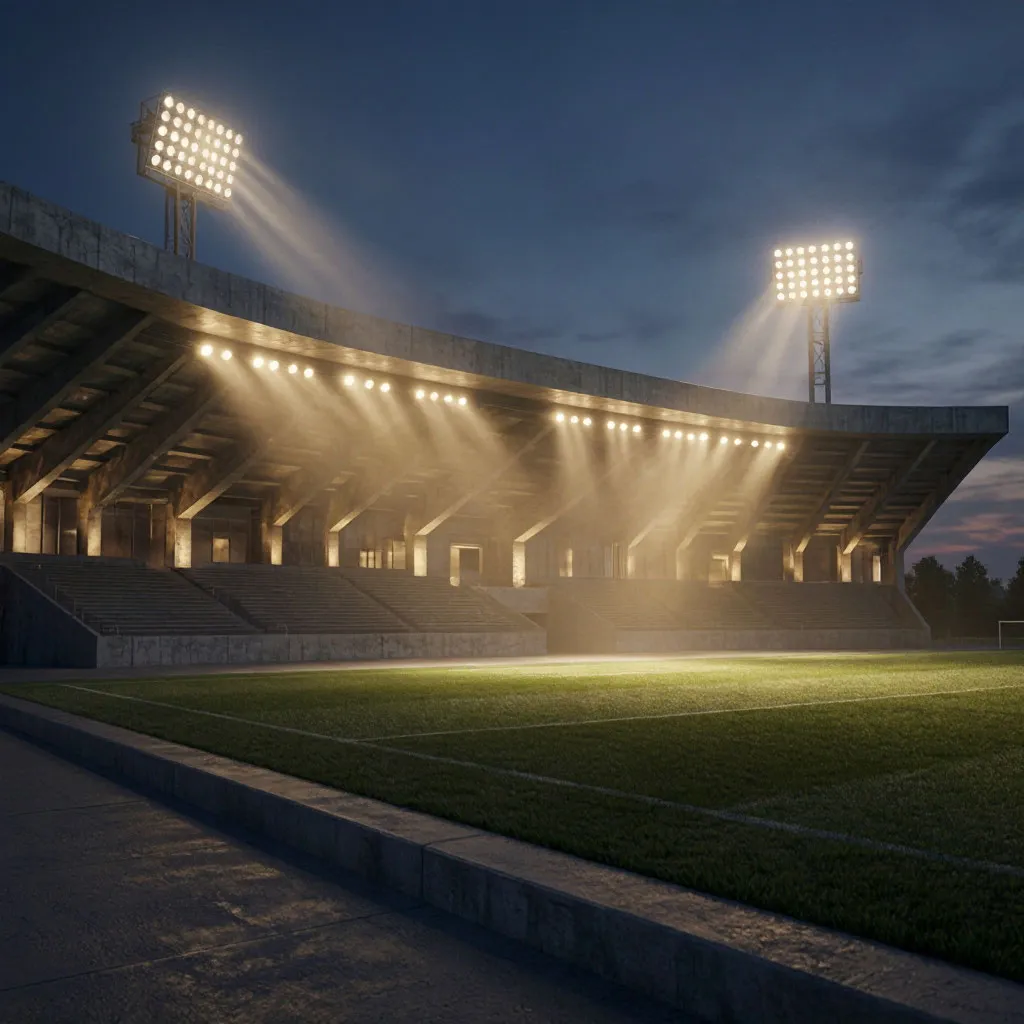
For years, parents in Gahanna, Ohio, have watched their kids’ soccer practices cut short as daylight fades, baseball games called on account of darkness, and softball tournaments limited to weekend mornings. The Gahanna City Council’s decision to approve new lighting for the city’s sports complex marks a turning point — not just for the athletes who use those fields, but for the entire community that surrounds them. Evening games, extended practice hours, and the possibility of hosting regional tournaments all hinge on one thing: the ability to see what you’re playing after the sun goes down.
Gahanna, a growing suburb northeast of Columbus, has been investing heavily in its public infrastructure. From the $59 million civic center complex on Tech Center Drive to the $100 million Creekside District redevelopment, the city has made clear that modernizing its facilities is a priority. The sports complex lighting project fits squarely within that vision — a targeted, high-impact upgrade that directly benefits youth sports leagues, adult recreational programs, and families who rely on public fields for healthy, structured activity.
What the council actually approved
The council vote authorizes the purchase and installation of LED field lighting at the Gahanna sports complex, covering multiple athletic fields used for soccer, baseball, softball, and football. The approval includes funding for the lighting fixtures, steel poles, electrical infrastructure, and installation labor. The project moves the complex from a daylight-only facility to one capable of hosting evening games and practices year-round.
The scope of the project involves several interconnected components that work together to deliver safe, reliable illumination for evening athletic activity:
- LED fixture installation: high-output LED sports lights mounted on poles ranging from 40 to 80 feet in height, depending on field configuration and the specific sport being illuminated.
- Electrical infrastructure upgrades: new conduits, transformers, and control panels to support the increased power demand, including smart control systems that allow remote operation and scheduling.
- Pole installation: galvanized steel poles anchored in concrete bases with integrated lightning grounding, engineered to withstand Ohio wind loads and weather conditions.
- Photometric design compliance: the lighting plan follows ANSI/IES RP-6 standards for sports illumination, ensuring appropriate foot-candle levels for each sport and level of competition.
- Glare and spill control: full-cutoff optics and precision aiming to minimize light trespass onto neighboring properties and reduce sky glow, a critical consideration for residential areas near the complex.
With the design phase complete and council funding approved, the project moves into procurement, where the city selects a qualified sports lighting contractor through a competitive bidding process.
Why LED changes everything for community sports
The choice of LED technology over traditional metal halide lighting is not incidental — it is the reason the project became economically viable. Metal halide systems, the standard for sports field lighting for decades, consume significantly more electricity, require longer warm-up times, and need frequent bulb replacement. LED fixtures use up to 50% less energy per fixture, turn on instantly, and last upwards of 50,000 hours with minimal maintenance. For a municipality managing a tight operating budget, those numbers make the difference between a project that pays for itself over time and one that becomes a financial burden.
The practical benefits of LED lighting for evening sports go well beyond energy savings. Players experience better visibility with more uniform light distribution, reducing shadows and dark spots that can cause misjudged plays and injuries. Spectators benefit from consistent illumination that makes watching evening games comfortable and safe. Coaches can run full practices after work hours instead of cramming into shrinking daylight windows. And the city gains the ability to schedule fields more efficiently, doubling or even tripling usable hours per field per day.
What residents and neighbors should know
Any lighting project in a residential community raises legitimate questions about impact on the surrounding neighborhood. Light spill, glare, traffic from evening events, and noise from extended hours of use are all concerns that Gahanna residents have raised — and that the council addressed during the approval process. The approved project includes specific mitigation measures designed to minimize disruption while maximizing the public benefit.
The project incorporates several measures to address community concerns about light pollution and neighborhood impact:
- Shielded fixtures with full-cutoff optics: all fixtures are designed to direct light downward onto the playing surface, preventing uplight that contributes to sky glow and reducing spill onto adjacent properties.
- Precision aiming and photometric study: each fixture is individually aimed according to a computer-modeled lighting plan that calculates exactly where light falls, ensuring illumination stays within field boundaries.
- Smart scheduling and dimming controls: the LED system supports multiple brightness levels, allowing the complex to operate at full output for competitive games and reduced output for practice sessions, further limiting neighborhood impact.
- Operating hour restrictions: the city’s use permit for the sports complex limits evening lighting to specified hours, typically ending by 10:00 PM on weekdays and 10:30 PM on weekends, with provisions for special events.
- Pre-installation neighbor notification: residents living within a defined radius of the complex receive advance notice of the project timeline, expected hours of operation, and contact information for concerns.
These measures reflect a growing trend in municipal sports lighting — the integration of DarkSky principles that balance the need for safe athletic illumination with responsible environmental stewardship. Communities across the country have demonstrated that well-designed LED sports lighting can coexist with residential neighborhoods when proper controls are in place.
The timeline and what happens next
With council approval secured, the project enters a multi-phase implementation process that typically takes six to nine months from vote to first night game. Understanding this timeline helps residents, coaches, and league organizers plan around the construction period and anticipate when the new lights will be operational.
The phases below represent the standard process for a municipal sports lighting project of this scale.
| Phase | Duration | Key activities | What residents will see |
|---|---|---|---|
| Procurement and bidding | 6-8 weeks | City issues RFP, evaluates contractor bids, awards contract | Public notices, council agenda items |
| Design finalization | 4-6 weeks | Contractor refines photometric plan, secures permits, orders materials | Surveying and site visits |
| Site preparation | 2-3 weeks | Ground marking, excavation for pole foundations, electrical trenching | Construction equipment on-site, limited field access |
| Pole and fixture installation | 4-6 weeks | Concrete pours, pole erection, fixture mounting, wiring | Cranes and lift equipment visible, fields closed |
| Testing and commissioning | 2-3 weeks | Electrical testing, aiming adjustment, light level verification | Brief nighttime testing, fields remain closed |
| Final inspection and handover | 1-2 weeks | City inspection, contractor walkthrough, documentation | Project complete, fields reopen |
The total timeline from council vote to first illuminated game is approximately 19-28 weeks, depending on weather conditions, supply chain availability, and contractor scheduling. Ohio’s construction season is heavily influenced by weather, so projects approved in late summer or early fall may see installation completed before winter, while those approved in winter may not break ground until spring.
Once the system is operational, the impact on daily life at the sports complex is immediate and transformative. Youth leagues can schedule evening practices that accommodate working parents instead of relying on after-school daylight. Adult recreational leagues gain access to fields after typical work hours. The city can host weekend tournaments that require evening games, bringing visiting teams and their families to Gahanna — a boost for local restaurants, hotels, and businesses.
What this means for the future of Gahanna athletics
The lighting project is not an isolated decision — it is part of a broader strategy to position Gahanna as a destination for youth and amateur sports in central Ohio. Communities that invest in quality athletic facilities attract tournament organizers, generate tourism revenue, and provide their own residents with recreational opportunities that rival or exceed those of neighboring cities. Gahanna’s proximity to Columbus, its growing population, and its commitment to infrastructure investment make it well-suited to capture this economic and social benefit.
The new lighting also addresses a practical problem that has grown with the city’s population: field scarcity. More families mean more children in sports leagues, and more teams competing for the same limited number of fields. Extending usable hours through artificial lighting effectively increases field capacity without the cost and land requirements of building new fields. A single field that currently supports 20 hours of weekly use can jump to 40-50 hours with evening lighting — the equivalent of adding a second field at a fraction of the cost.
For the athletes themselves, the impact is personal. A high school soccer player who currently finishes practice as the sky darkens at 5:30 PM in November gains two additional hours of training. A Little League baseball team that loses games to early sunsets in April can complete its schedule. A adult softball league that could never find field time after work suddenly has a home. These are not abstract benefits — they are the tangible, daily reasons why this council vote matters to the people who play, coach, and watch sports in Gahanna.
Living with the lights: a long-term perspective
The first time the new lights click on at the Gahanna sports complex, the moment will feel monumental to those who pushed for the project. But the real measure of success is what happens five and ten years later — when the lights have been running every evening through countless seasons, when the energy savings have accumulated into meaningful budget relief, and when a generation of young athletes has grown up never knowing a time when their home fields went dark at sundown.
Municipal projects like this succeed when the community owns them — when residents understand what was built, why it matters, and how it fits into the larger story of a city investing in its future. Gahanna’s sports complex lighting is not just about seeing better at night. It is about a community deciding that its children, its families, and its recreational life deserve the same quality of infrastructure that its business district and civic center receive. The lights will go on, the games will continue after dark, and the fields that have served this city for years will serve it even better from here forward.