
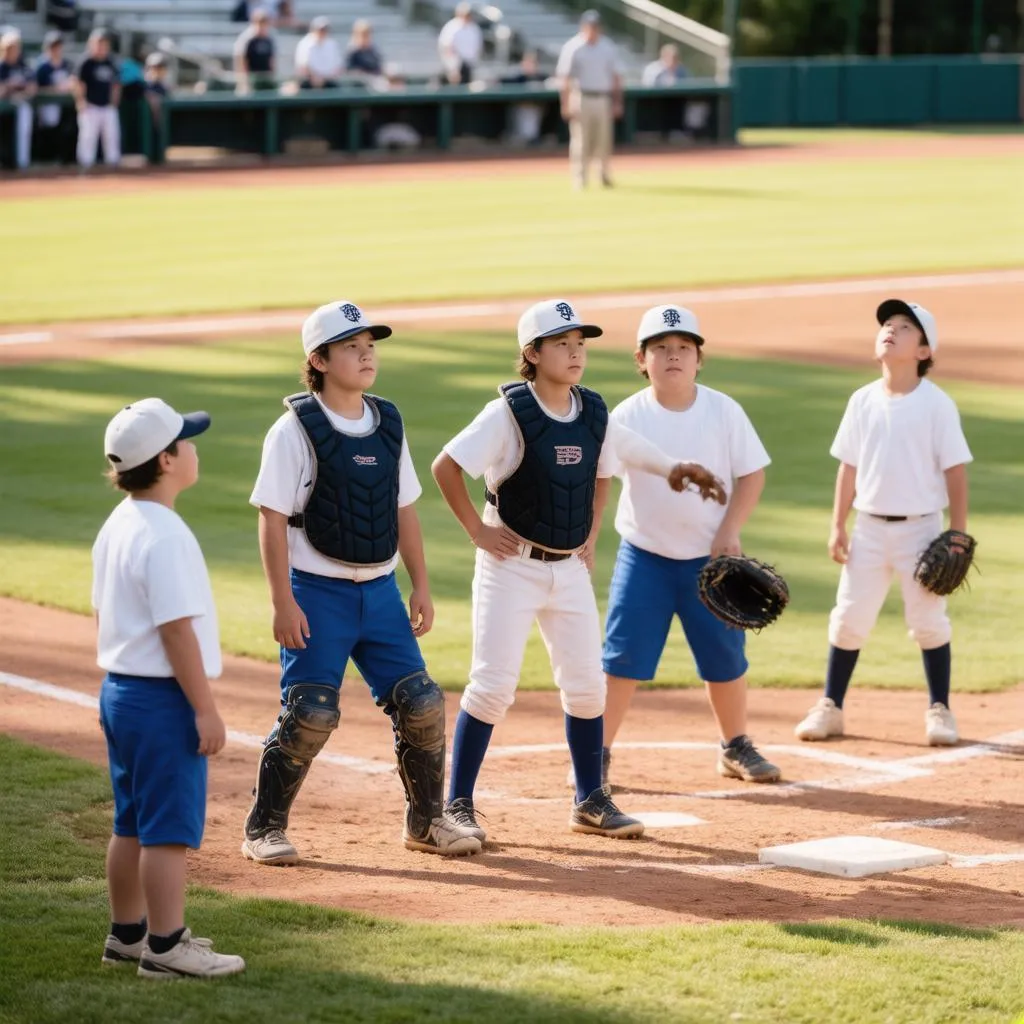
Watch a youth baseball game from the bleachers and it can look like chaos: nine kids scattered across the diamond, everyone running somewhere the moment a bat cracks. From inside the fence, though, nothing is random. Every player has a defined spot, a defined job, and a set of situations they prepare for. Once a young player understands what each position actually demands, the game slows down, decisions become obvious, and practice starts to feel like it has a direction. This guide walks through all nine defensive positions, the skills each one rewards, and how a young athlete can figure out where they belong.
How the defense is arranged
Baseball’s defense divides into three zones. The pitcher and catcher form the battery in the middle of the diamond. Four infielders occupy the area between the base paths, and three outfielders patrol the grass beyond them. The numbering system coaches use comes from the scorecard: the pitcher is 1, the catcher 2, first base 3, second base 4, third base 5, shortstop 6, left field 7, center field 8, and right field 9. Parents hear these numbers constantly in the stands — a “6-4-3 double play” simply means shortstop to second baseman to first baseman — and players who know them communicate faster during games.
The battery: pitcher and catcher
The pitcher touches the ball on every single play, which makes this the most mentally demanding spot on the field. Youth pitchers need to throw strikes consistently, field their position on ground balls back to the mound, and cover home plate on wild pitches. Arm care matters more than anything else here: pitch counts exist for a reason, and a young arm that learns proper mechanics early stays healthy for years. The best youth pitchers are usually not the ones who throw hardest but the ones who throw their fastball where they want it.
The catcher is the defense’s control tower. Crouched behind the plate in heavy gear, the catcher receives every pitch, blocks balls in the dirt, frames borderline strikes, and calls out baserunners trying to steal. Catching requires toughness, strong legs, quick feet, and a personality comfortable with responsibility, because the catcher sees the whole field and talks to every teammate. Good youth catchers are rare and precious; a coach who finds one builds the team around that player.
The infield: four players, four very different jobs
The first baseman plays the closest spot to the action and handles more catches than anyone else, because throws from every direction converge on first base. Height and reach help, but the real skill is footwork around the bag: stretching for a throw, coming off the base to field a bad hop, and scooping balls in the dirt. First base rewards patience and soft hands more than blazing speed.
The second baseman covers the gap between first and second and works in constant partnership with the shortstop. The position demands quick lateral movement and the ability to make fast, accurate throws from awkward angles, often while pivoting on a double play. Because the throw to first is shorter from second base, the position suits players with strong instincts and quick hands rather than the strongest arms.
The shortstop sees more action than any other fielder. Ground balls, pop-ups behind third, tags at second, relays from the outfield — everything runs through this spot. Shortstop asks for the full package: range, a strong and accurate arm, soft hands, and the confidence to take charge. Many youth coaches place their best overall athlete here, which is why shortstop so often produces future team leaders.
The third baseman stands a few steps from the batter, earning the position its classic nickname, the hot corner. Hard-hit balls arrive fast and on a sharp angle, so reaction time is everything. A strong throwing arm is essential because third basemen regularly make long cross-diamond throws to first base. Courage helps too — there is no time to flinch at a screaming line drive.
The outfield: reading the ball in the air
The left fielder generally covers the area behind third base and shortstop. In youth games, most right-handed hitters pull the ball to left, so this position fields a steady stream of chances. Left fielders need reliable hands, a decent arm for throws to third, and the awareness to back up third base on plays down the line.
The center fielder is the outfield’s quarterback, covering the most ground and calling off teammates when a fly ball hangs between them. Speed is the top requirement, along with the ability to read a ball off the bat instantly and take the straightest route to it. Center fielders also back up second base, which means constant movement even when the ball is not hit their way.
The right fielder has the longest throw on the field — straight to third base — so arm strength is the defining trait. The position also demands patience, because right field can be quiet for innings at a stretch, then suddenly produce a critical play. A right fielder who stays engaged and anticipates the ball pays off when it matters.
Matching skills to positions
No two young players develop at the same pace, and the position a child plays at age nine may not be the one at thirteen. Still, certain abilities point toward certain spots, and recognizing them early helps a player focus practice where it counts. These are the traits coaches notice first:
- Consistent throwing accuracy and composure point toward pitcher or catcher
- Quick hands and lateral speed fit second base and shortstop
- A strong arm suits third base, right field, and catcher
- Straight-line speed belongs in center field
- Height, reach, and soft hands make first base a natural home
- Patience and focus are the currency of outfield positions
The list is a starting point, not a sentence. A shortstop with a growing arm can become a third baseman; a speedy outfielder with soft hands can slide into the middle infield. What stays constant is the underlying skill — speed, hands, arm strength, awareness — and those transfer everywhere.
The nine positions at a glance
With the basics covered, it helps to see everything side by side. Each position balances physical demands, mental demands, and how often the ball finds it during a typical game.
| Position | Where they play | Key skills | Ball comes here |
|---|---|---|---|
| Pitcher | Center of the diamond | Accuracy, composure, arm care | Every play |
| Catcher | Behind home plate | Toughness, quick feet, leadership | Every pitch |
| First baseman | Near first base | Reach, footwork, soft hands | Often |
| Second baseman | Between first and second | Quickness, fast pivot throws | Often |
| Third baseman | Near third base | Reflexes, strong arm | Regularly |
| Shortstop | Between second and third | Range, arm, instincts | Most often |
| Left fielder | Grass behind third | Sure hands, backup awareness | Sometimes |
| Center fielder | Deepest outfield grass | Speed, reads, communication | Regularly |
| Right fielder | Grass behind first | Arm strength, patience | Sometimes |
The spread tells a quiet story: middle infield and center field demand the most range, the corners reward arms and hands, and the battery absorbs the most mental pressure. A young player who struggles in one spot may thrive in another, so early struggles are information, not failure.
Finding the right position: a step-by-step approach
Choosing a position works best as a process rather than a single decision, and young players who experiment deliberately develop faster than those locked into one spot too early. A simple path looks like this:
- Try every position in practice, even briefly, so the player feels what each one demands rather than guessing from the sidelines.
- Notice what feels natural, whether that is catching fly balls, fielding grounders, or handling the ball behind the plate.
- Ask for honest feedback from the coach about arm strength, speed, and instincts, since self-assessment at a young age is rarely accurate.
- Commit to two positions for the season — a primary and a backup — and practice the specific skills each requires.
- Reassess each year, because growth spurts, stronger arms, and better coordination regularly change the picture.
Following this sequence keeps the experience flexible and fun. Players who bounce around early usually become more complete athletes, and coaches value that versatility deeply once teams get older and rosters get smaller.
Where defense and offense meet
Every position also carries expectations at the plate, and youth lineups usually reflect them. Middle infielders and center fielders tend to bat toward the top of the order because they are fast and see many at-bats. Corner positions and the catcher often hit in the middle, where power matters. Pitchers in youth leagues typically bat too, though many leagues now use designated hitters. None of this is rigid, but knowing the connection between fielding spot and lineup spot helps a player understand their full role instead of thinking of hitting and fielding as separate games.
Practice tips by position
Generic practice makes generic players, so each spot deserves its own training focus. A short routine matched to the position beats an hour of unspecific throwing:
- Pitchers work on locating fastballs to both sides of the plate and fielding comebackers
- Catchers practice blocking balls in the dirt and quick throws to second
- Infielders take ground balls daily and work on proper footwork to the glove side
- Outfielders practice drop steps, fly ball reads, and hitting the cutoff man
- First basemen scoop balls in the dirt until it becomes automatic
Fifteen focused minutes per session on position-specific work adds up over a season. The players who improve fastest are rarely the ones who practice the longest but the ones who practice the right things.
Final thoughts for young players and parents
Positions in baseball are not boxes that limit a player; they are roles that give every child a way to contribute. The quiet kid with soft hands becomes a first baseman. The fearless sprinter owns center field. The steady thinker thrives behind the plate. Learning the nine spots — where they stand, what they do, and what they demand — turns a confusing scramble into a coordinated team effort, and it gives every young player a clear answer to the question that matters most on the field: when the ball is hit, where do I go?