
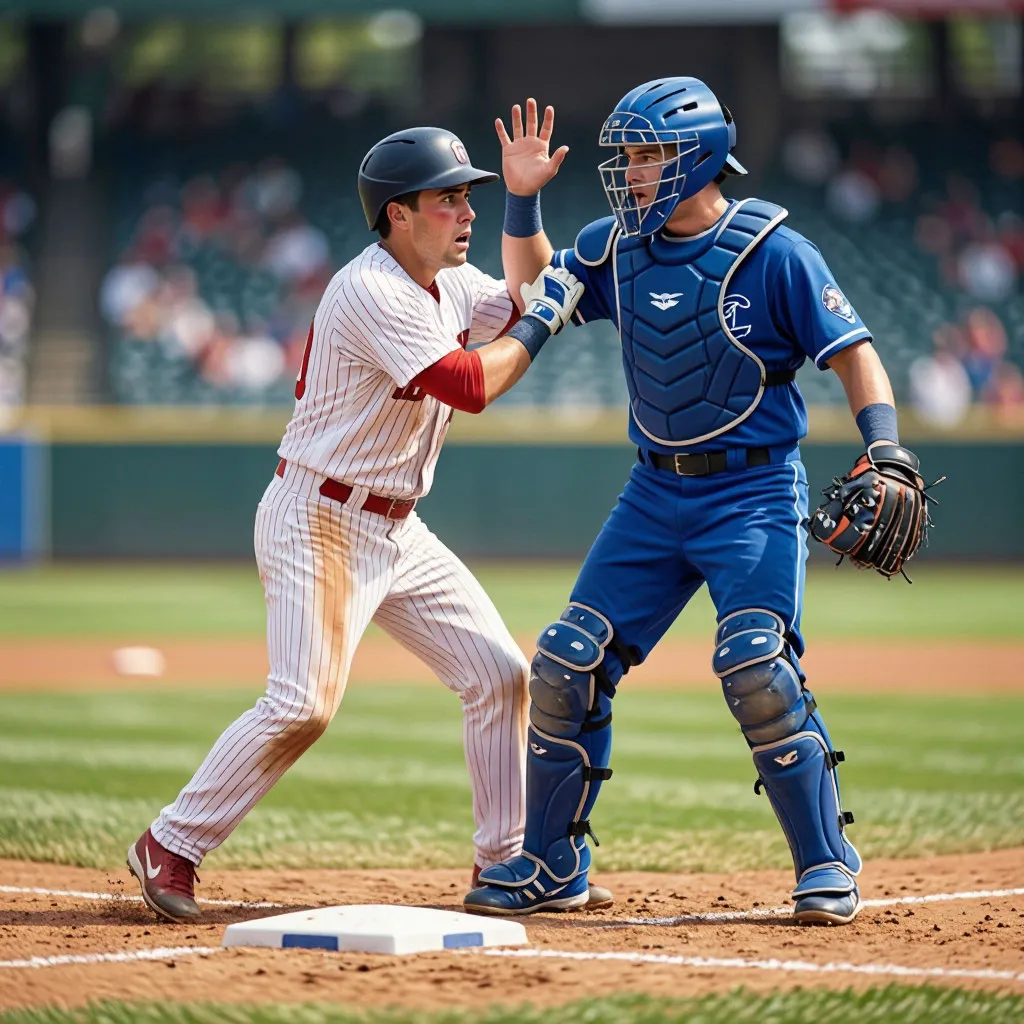
Few rule debates cause more arguing at a youth ballpark than interference and obstruction. Parents on opposite bleachers shout the same word at the umpire from different sides of the field, and half the time they are using the wrong one. The confusion is understandable, because the two terms describe mirror-image offenses: one is about offense getting in defense’s way, and the other is about defense getting in offense’s way. Once the direction of the fault is clear, the rest of each rule falls into place quickly, and the next disputed play at home plate can become a teaching moment instead of an argument.
The one-sentence version
Interference is a violation by the team at bat — a batter, runner, or on-deck hitter who hinders a fielder making a play. Obstruction is a violation by the defense — a fielder who blocks a runner’s path without the ball or without being in the act of fielding. That is the whole distinction at its core, and everything else in the rules is detail layered on top of it. A useful memory trick: interference is what runners do to fielders, obstruction is what fielders do to runners.
Interference in detail
Interference comes in several forms, and umpires treat them differently. The most common type at youth level is runner’s interference, where a baserunner contacts a fielder who is actively fielding a batted ball or attempting a throw. Batter’s interference occurs when a hitter hinders the catcher, most often by swinging and making contact with the catcher or his glove on a pitch. There is also fan interference on batted balls, and catcher’s interference — a quirk of the terminology — which is technically charged against the defense when the catcher’s glove touches the bat during a swing.
The penalties vary with the situation. Interference by a runner with a fielded ball typically makes the runner out and sometimes kills the play entirely, sending other runners back to their last base. Batter’s interference with the catcher results in the batter being called out, except in cases where runners are advancing with two outs, which changes the outcome. Umpires have judgment calls to make on every one of these: was the fielder making a play, did the contact actually hinder the fielding attempt, and would the play have succeeded anyway.
Obstruction in detail
Obstruction happens when a fielder without the ball — and not in the immediate act of catching one — impedes a runner’s progress. The classic image is a catcher standing up the base line before the ball arrives, or a first baseman planted in front of the bag with the throw still in the air. Rulebooks divide obstruction into two categories with different penalties:
- Type 1 obstruction, when the fielder blocks a runner and is not making a play on the ball at all, awards the runner the next base immediately
- Type 2 obstruction, when the fielder is involved in the play but positioned illegally, lets the play unfold and allows the umpire to impose the remedy that would have occurred without the block
The distinction between the two types is where most live arguments come from, and it is also why umpires hesitate before making the call. Under both versions, the umpire is reconstructing what would have happened — would the runner have reached third, would the throw have beaten him home — and that judgment is protected by rule: arguing judgment calls is not a protestable offense.
The comparison at a glance
With both definitions on the table, the contrasts become easy to see. The same play can involve neither, one, or — in chaotic moments — both, so the side-by-side view helps players and parents diagnose what they actually watched:
| Aspect | Interference | Obstruction |
|---|---|---|
| Who commits it | The offense (batter, runner) | The defense (fielder, catcher) |
| Typical example | Runner hits a fielder fielding a grounder | Catcher blocks the plate before the ball arrives |
| Standard penalty | Runner or batter called out | Runner awarded a base or protected position |
| Intent required | No — accidental contact can be interference | No — accidental blocking counts too |
| Judgment element | Whether hindering actually occurred | What would have happened without the block |
| Verbal cue parents shout | “He interfered!” | “He obstructed the runner!” |
Reading across the rows, the logic becomes intuitive: each rule exists to restore fairness for the party that was impeded. The offense that hinders defense loses the advantage of the play; the defense that hinders offense must give the runners the progress they were denied.
Situations players should know cold
Certain plays produce most interference and obstruction calls at the youth level, and players who learn them in advance avoid the penalties entirely. The recurring scenarios include:
- A runner rounding third and colliding with the third baseman, who has neither the ball nor a play in progress
- A batter stepping out of the box into a catcher’s throw on a steal attempt
- A runner on first sliding into the second baseman covering the bag, when the throw has already arrived
- A catcher without the ball straddling the base line as the runner bears down on home
- A runner intentionally waving an arm to distract the catcher during a play at the plate
Each of these is teachable in a single practice session. Runners should be coached to run the base line and expect the fielder’s right to the ball, while fielders should learn to give up the base path until possession is established. The best habit for a young fielder is simple: no ball, no body in the path.
The rules that protect the runner
Obstruction rules also grant runners protections that are easy to overlook. A runner cannot be called out for missing a base he was prevented from touching by a blocking fielder; the umpire awards it. A runner who is obstructed while a play develops keeps the benefit of the doubt on any close outcome. And a runner may legally run over a fielder who has blocked the path without the ball, because the fielder created the situation — though at youth levels, rulebooks commonly require sliding or avoidance at home plate for safety. These protections are why umpires are trained to watch the fielder’s position before the ball arrives, not only the collision itself.
Verbal and visual signals umpires use
Umpires communicate these calls differently, and knowing the signals removes most of the bleacher confusion. For obstruction, the umpire typically extends an arm horizontally with a fist clenched — the “that’s obstruction” signal — while letting the play continue before announcing the penalty. For interference, the call is more immediate and definitive, often paired with an emphatic out call and a dead ball. Listening for the words matters too: an umpire saying “that’s obstruction” is deliberately different from “he’s out,” and the first does not end the play. Coaches who teach players these signals keep their teams from prematurely jogging off the field in either direction.
Coaching points that prevent both calls
The cheapest way to handle interference and obstruction is to make them rare, and that happens through specific habits rather than lectures. A shortlist for coaches covers most of the ground:
- Teach runners that the base path belongs to the fielder with the ball or a play in progress
- Teach catchers to move up the line only after receiving the ball, then dive across the plate’s front edge
- Drill infielders to clear the base path immediately after releasing a throw
- Practice the batter’s box rule — hitter must vacate on plays at the plate involving the catcher’s throw
- Rehearse sliding technique so contact happens low and controlled when it is unavoidable
Teams that drill these situations play cleaner games and, just as importantly, keep the emotional temperature of close contests down. A collision that both sides understand as legal rarely turns into a shouting match; one that nobody understands almost always does.
Knowing the rules changes the game
Interference and obstruction are not exotic provisions of the rulebook; they are the rules that govern the most physical, most emotional moments in baseball — plays at the plate, steals, collisions at first base. A young player who understands them plays smarter and safer. A coach who teaches them eliminates an entire category of avoidable outs and errors. And a parent who knows the difference between the two words spends the seventh inning cheering instead of arguing with a volunteer umpire who, in all likelihood, got the call right.