
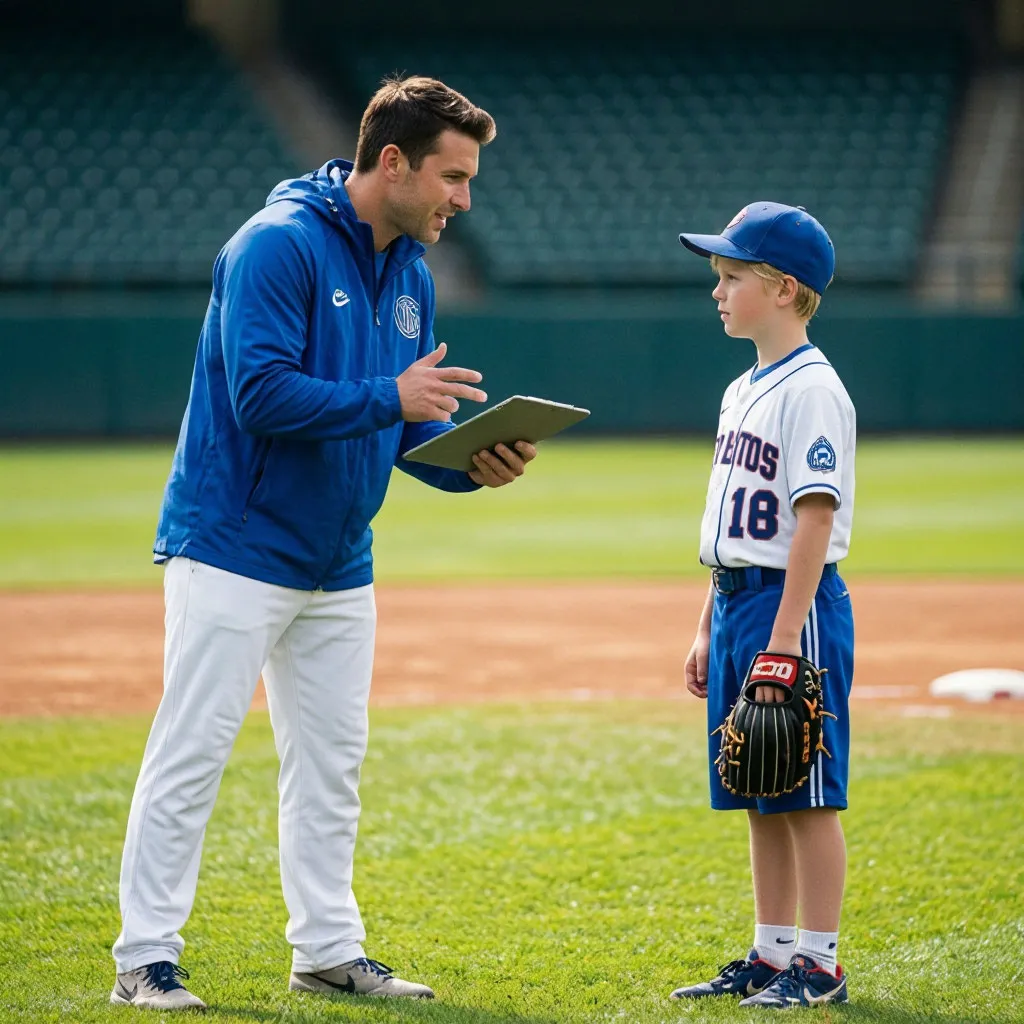
The throw looked fine from the bleachers. Arm snapped through, ball popped the glove, the kid walked off the mound like it was nothing. What parents rarely see in that moment is the accounting happening inside a twelve-year-old elbow — growth plates, tendons and ligaments still under construction, absorbing every pitch like a small debt that gets collected years later. Overuse injuries in youth pitchers have grown common enough that the largest medical bodies in baseball have spent two decades building simple, public rules to prevent them. Those rules work, but only when the adults around the player actually know them.
This guide walks through the whole system: how many pitches are safe at each age, how rest days are calculated, what a real arm care routine looks like, and the honest answer to the question every young thrower asks first — when can I throw a curveball? The short version is that pain is never a normal part of pitching, workload matters more than any single pitch type, and the players who last longest are the ones whose arms were protected when they were ten.
Why pitch counts exist in the first place
A young arm is not a smaller version of an adult arm. The growth plate at the inner elbow — the medial epicondyle — is the weakest link in a child’s throwing chain, and repetitive stress on it causes what doctors callLittle League elbow: inflammation, and in severe cases, separation of the plate itself. The ligament on the opposite side, the ulnar collateral ligament, faces the same chronic load and is the one surgeons reconstruct in professional pitchers. Neither structure is designed to throw through fatigue, which is why the rules that follow are built around two measurements: total pitches thrown in a day, and full days of rest afterward.
The thresholds below come from the Pitch Smart guidelines developed by MLB and USA Baseball, which most leagues, travel programs and school associations now adopt directly.
| Age | Max pitches in a day | Rest needed for 21–35 pitches | Rest needed for 36–50 pitches | Rest needed for 51+ pitches |
|---|---|---|---|---|
| 7–8 | 50 | 1 day | 2 days | 3 days |
| 9–10 | 75 | 1 day | 2 days | 3 days |
| 11–12 | 85 | 1 day | 2 days | 3 days |
| 13–14 | 95 | 1 day | 2 days | 3 days |
| 15–16 | 95 | 1 day | 2 days | 3 days |
| 17–18 | 105 | 1 day | 2 days | 3 days |
The numbers read a little abstract until you apply them to a real season. An eleven-year-old who throws 60 pitches on Saturday needs three full days off before pitching again — meaning Tuesday, not Monday, and no sneaky relief appearance in between. For older teenagers the scale stretches further: at fifteen and up, anything over 76 pitches in a day demands four days of rest. Leagues enforce the counts on paper, but tournaments are where limits go to die, because a single weekend with three games can quietly triple a child’s weekly workload. Parents are the last line of defense there, since no tournament director will ever ask your son to sit out the semifinal.
The rules that trip parents up
Beyond the daily numbers, a few quieter rules cause most of the real-world problems, and they deserve their own accounting. Pitchers and their families should keep these in mind from the first spring practice:
- Catching counts as throwing — a pitcher who catches the next day doubles the arm stress, so the same child should generally not pitch and catch in the same week, and never on consecutive days;
- One team is a full-time job — playing for a school and a travel team at once is the single most common cause of blown limits, because neither coach sees the other roster’s pitch log;
- Showcase velocity is not free — throwing max-effort bullpen sessions for radar guns between starts adds a hidden pitch count no one records;
- Year-round baseball is the risk factor — at least two to three months off from overhead throwing each year, ideally across different sports, is the recommendation for players under fifteen;
- No pitcher under fatigue is an exception — soreness, wildness late in an outing and dropping velocity are all signals to pull the arm out of the game immediately.
What ties these together is a simple principle: the arm does not distinguish between innings in a league game, pitches in a tournament final and throws in the backyard. It only adds them up. A family that tracks total volume across every team, practice and showcase will already be ahead of ninety percent of the travel circuit.
Arm care that actually does something
Long-toss videos and resistance bands flood every youth baseball feed, and a fair amount of it is decoration. Real arm care is smaller and more boring than social media suggests, and it happens on a weekly rhythm rather than in heroic single sessions. A sensible routine for a developing pitcher looks like this:
- Warm up before every throw, every time — five to ten minutes of light running and dynamic movement, then easy short toss at close range before any full-distance throwing;
- Build throwing volume gradually — increases in distance, intensity or pitch count should come in small steps across weeks, never all in one showcase weekend;
- Strengthen the whole chain, not just the arm — core, hips, legs and scapular work matter more for arm health than forearm curls, because the legs absorb what the elbow otherwise pays for;
- Throw from a mound less than you think — flat-ground throwing at game effort is a legitimate skill builder with lower stress, useful for pitch shapes and command work;
- Take the full rest days seriously — the day after a start should involve no throwing at all, and the second day can be light catch or band work if the arm feels normal.
Consistency beats intensity in this domain the way it does in almost nothing else in sports. A twelve-year-old who does modest band work and core strengthening three times a week, all year, has measurably better outcomes than one who does an elaborate three-hour arm care session the week before tryouts. The routine also builds a baseline: a player who knows what his arm feels like on a normal day is far better at recognizing the day it doesn’t.
When the arm is saying stop
Kids hide injuries — partly out of toughness, partly because they suspect the answer will be more rest, and partly because the adults around them are visibly invested in the season. Parents need to know the specific signs, because vague “it’s fine” answers are the norm. Pay attention if any of these show up and repeat across more than one outing:
- Pain anywhere in the elbow or shoulder during or after throwing;
- A drop in velocity that the player himself notices and mentions;
- Loss of control that appears suddenly after months of consistency;
- swelling around the elbow or shoulder, or stiffness the next morning;
- A changed throwing motion that the player adopts without being taught;
- Pain that returns every time the child throws, even after several days off.
Soreness that lingers, recurs or worsens is not a conditioning problem — it is the classic early signal of overuse damage, and the right move is to shut down throwing and get an evaluation from a pediatrician or a sports medicine specialist before the next practice. One quiet week off in April is the cheapest insurance in youth sports. The alternative — a growth plate injury managed by ignoring it — can cost an entire season or more, and no playoff run balances that ledger.
The breaking ball question, answered honestly
Now for the part every young pitcher really wants to know. The Pitch Smart recommendations lay out a rough timeline for introducing pitch types, built around how much stress each one puts on the elbow and shoulder. The sequence most programs follow runs like this:
- Four-seam and two-seam fastball — the foundation, appropriate from the earliest ages;
- Changeup — recommended from around age ten, and arguably the most valuable developmental pitch in baseball because it teaches arm speed with low stress;
- Curveball — generally introduced around age fourteen, once the pitcher has command of both fastball and changeup;
- Slider and other cutting pitches — usually reserved for sixteen and older, when arm strength and mechanics are more mature;
- Forkball and splitter — adult-level pitches, best left to fully developed arms.
The honest nuance is that the curveball controversy has softened in recent research. Multiple large studies have found that the curveball itself, thrown with decent mechanics, is not the injury villain it was made out to be — fastball volume and total workload correlate with injury far more strongly than any single pitch type. What the age recommendations protect against is the twelve-year-old throwing thirty curveballs a game, every game, on a growth plate that is still open. A changeup is both the safer option and, over a career, the more useful pitch, which is why nearly every professional development system funnels young throwers through it first.
If a coach is genuinely teaching breaking pitches to a young player, look at how he does it. A good instructor introduces the grip and the slow, spin-focused mechanics on flat ground at partial effort, keeps the volume modest, and treats the pitch as a garnish rather than a meal. A program whose twelve-year-olds live on breaking balls at max effort is telling you something about its priorities that has nothing to do with your child’s long-term arm.
A closing thought for the ride home
Every element of this system — the counts, the rest days, the delay on breaking pitches — is really one idea wearing different outfits: a young arm is a long-term asset, and the season that matters most is not the one happening right now. The players who reach high school throwing hard, healthy and confident are almost always the ones whose parents treated their ten-year-old elbow like it belonged to someone who would still be pitching fifteen years later. Because it does. The radar gun at a weekend tournament has no memory of any of this, but the arm keeps perfect records — and it is the only scorecard that follows a player all the way to the end.